

 ADVERTISEMENT
A volcano in Iceland has erupted for the fifth time in three months.
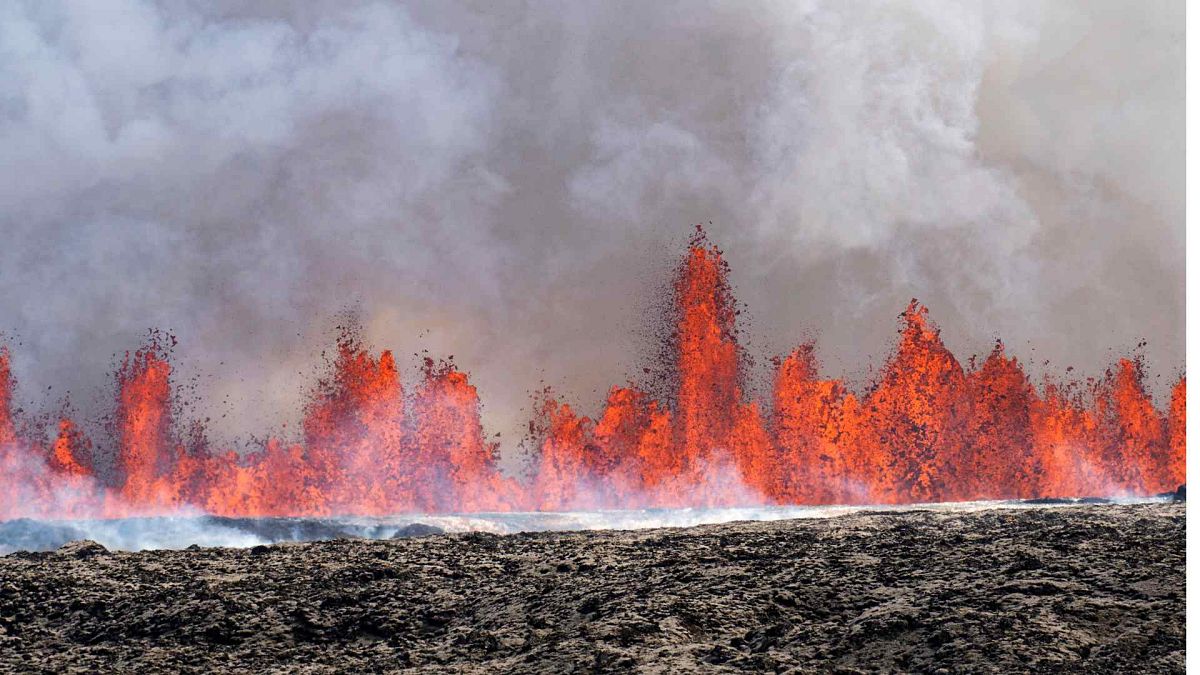
Lava can be seen spilling from the Sundhnúkur crater row. It began in the early afternoon today, 29 May, and it is ongoing.
Visitors have been evacuated from the Blue Lagoon thermal spa, one of Iceland’s top tourist attractions, and it remains closed.
The eruption site is a few kilometres northeast of Grindavik, a coastal town of 3,800 people about 50 kilometres southwest of Iceland’s capital, Reykjavik. Grindavik has been evacuated and the roads around it are closed.
Despite lying just 20 km north of the eruption site, Keflavik International Airport - Iceland's main international airport - remains open and flights are still arriving and departing. However the airport advised passengers to "monitor flight information".
If you are planning on travelling to or from the affected area, here are the full details on advice from European governments and airlines.
How long will Iceland's volcano eruption last?
Iceland’s Meteorological Office says "Intense seismic activity is ongoing on the Sundhnúkur crater row.
A magma propagation might be starting or has started, and a volcanic eruption could follow."
The Met Office says lava is shooting about 50 metres into the sky from a fissure about 3.5 kilometres long.
The Grindavik community was previously evacuated in November following a series of earthquakes that opened large cracks in the earth between the town and Sýlingarfell, a small mountain to the north.
Before the recent eruptions, the Svartsengi volcanic system north of Grindavik had been dormant for around 780 years. The volcano is just a few kilometres west of Fagradalsfjall, which was dormant for 6,000 years before flaring to life in March 2021.
Iceland's volcano eruption 'is not a tourist attraction'
During a recent eruption, Icelandic authorities declared a state of emergency after hundreds of small earthquakes shook the Reykjanes Peninsula - the island nation’s most populated region.
“This is not a tourist attraction and you must watch it from a great distance," Vidir Reynisson, head of Iceland’s Civil Protection and Emergency Management, told national broadcaster RUV.
Yet the spectacular natural phenomenon is hard for people to resist. “It’s just [like] something from a movie!” said Robert Donald Forrester III, a tourist from the United States.
For local residents, the emotions were mixed. “The town involved might end up under the lava,” said Ael Kermarec, a French tour guide living in Iceland. "It’s amazing to see but, there's kind of a bittersweet feeling at the moment.”
Have flights to Iceland been cancelled?
Despite concerns over the impact the eruption will have on travel, nearby Keflavik Airport remains operational. Icelandic airport operator ISAVIA advises passengers to monitor flight information here.
Volcanic eruptions can pose a serious hazard to air travel as ash released into the atmosphere can cause jet engines to fail, damage flight control systems and reduce visibility.
However, the airport has said they were used to volcanic activity and well-prepared to deal with it without needing to close the airport.
ADVERTISEMENTIceland's Civil Protection and Emergency Management say, "Iceland is no stranger to volcanic activity and experiences an average volcanic event every five years.
Icelandic authorities and the public are highly prepared for such events, and Iceland has one of the world’s most effective volcanic preparedness measures.
Iceland’s geoscientists possess vast experience in dealing with volcanic activities."
A major eruption in Iceland in April 2010 caused widespread disruption to air travel between Europe and North America. The quarter of a billion cubic metres of volcanic ash it ejected into the air led to more than 100,000 flights being cancelled over an eight-day period.
Though there had been fears of a repeat, Eyjafjallajokull volcano erupted under circumstances that contributed to the immense size of its ash cloud. A glacier on top of it caused meltwater to rapidly cool the lava, creating tiny particles which were launched into the air by the steam produced in the eruption. These were then carried on the wind towards Europe.
ADVERTISEMENTIn the past three years, three eruptions have taken place on the Reykjanes Peninsula with no impact on air travel.
The European Aviation Safety Agency (EASA) is also better prepared for a major volcanic ash event.
"In the event of an eruption and development of an ash cloud, the agency will work with other aviation actors to assess the impact for aviation and make recommendations accordingly," a statement on the EASA's website from November reads.
Is it safe to travel to Iceland?
Travellers are advised to stay away from Grindavik and respect local restrictions. Visit the Icelandic Met Office and Safe Travel Iceland for the latest advice.
Otherwise, Iceland is currently a safe destination.
ADVERTISEMENTKeflavik International Airport and the road to it is unaffected and operating normally.
Countries have not issued a ‘no-go’ travel warning for Iceland meaning that airlines and holiday companies are operating as normal and travellers who cancel their bookings have no automatic right to a refund.
During a previous eruption Jonathan Frankham, general manager of travel insurance company World Nomads, said: “For those concerned about travel insurance coverage, and whether cancelling a trip is best, we’d advise travellers to exercise common sense and travel wisely," says
"It’s important to note that policies purchased after the earthquakes and consequential volcanic eruption became a 'known event' are unlikely to be covered, but we recommend checking your policy wording for exact details."
He advised tourists to contact their airline or travel provider for assistance and the latest information.
ADVERTISEMENTIs the Blue Lagoon open?
The Blue Lagoon geothermal spa - one of Iceland’s biggest tourist attractions - was evacuated when the volcanic eruption began.
The spa is still closed, according to the official website, and will remain closed until 31 May.
It says: "Due to a volcanic eruption that commenced in Sundhnúksgígar on May 29, we took the precautionary measure of evacuating and temporarily close all our operational units today.
Further updates and information will be provided here as they become available."
Blue Lagoon management said that all customers with bookings would be contacted, and anyone wishing to change or cancel their booking can do so on the official website.
ADVERTISEMENT