

I’m standing beside a big white cross at the summit of La Chaux. The sun is burning my shoulders and I can hear crickets chirping and bees droning.
Below is a deep valley of dark pine trees shading rustic wooden chalets. In the distance are pale blue mountains, the peaks topped by snow.
Visitors to this area of the French Alps are more likely to observe this view in winter, blanketed by snow.
But as global warming hits, more and more mountainous regions in Europe are relying on their aestival attractions to entice holidaymakers.
This year began with worrying weather conditions. France experienced the driest winter for over 60 years and Météo-France reported no precipitation between 21 January and 21 February.
For the Alps, it was the longest winter drought since record-keeping started in 1959.
In June, I travelled to Morzine in the Portes du Soleil ski area to find out how one chalet rental company is leaning into summer tourism.
Climate change shortens ski season
AliKats chalets are dotted around Morzine and the mountainside above the town. I’m staying in their converted 1808 farmhouse in the hamlet of Montriond, where nobody locks their doors.
The rental company is better known for offering luxury self-catered winter ski chalets that are rigorously sustainable.
But climate change has been causing a shorter and unpredictable ski season, prompting Alikats to evolve their tourism approach.
I arrive at the end of June, as chalet balconies bloom with flowers, horses graze on lush hillsides and a fierce sun quickly burns off the morning chill.
I’m here to experience one of the company’s summer retreats, where mindfulness and personal growth are practised through total immersion in Alpine allure.
A summer retreat in the Alps
In midsummer, the Alps are in a moment of fullness and abundance. Wildflowers spring up unbridled, vibrant green shoots tip the tree branches, and everything is a picture of health and colour.
I, too, am hoping to feel a sense of thriving and wellness as I arrive at AliKats’ Summer Flourishing retreat.
The first task is for participants to enter into the right frame of mind. The group of seven begins with a qi gong yoga session where we change our energy and stimulate pressure points in the body using an ancient Chinese practice.
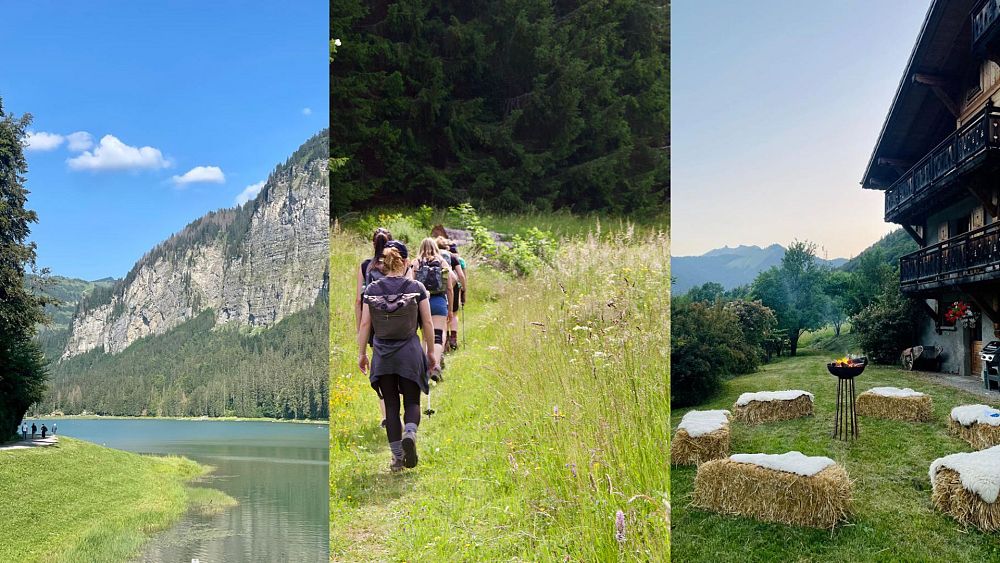
We do this on a grassy area outside the AliKats chalet, wind cooling our faces and the sun-dappled valley stretching out below.
We then take a gentle walk for our first exercise with Caitlin, a professional life and leadership coach.
Prior to the retreat, I had a 2-hour briefing session where Caitlin helped me identify my core values, my life goals and what I wanted out of the retreat.
Over the course of the five days, we work on aligning with inner purpose and intentions through group discussion, paired talks and one-on-one sessions with Caitlin.
What to do in the Alps: Hiking and lake swimming
As Caitlin explains, reconnecting with nature is fundamental to opening our minds and stimulating personal growth.
The retreat includes three day hikes in the magnificent Alpine surroundings. We walk through fragrant pine forests, bright wildflower meadows, verdant valleys and rocky passes.
Our final day hike takes us up to the border with Switzerland at the Col de Cou pass. As we discuss setting intentions for our return to reality, we gaze upon the formidable peaks of mountains still bearing patches of pristine snow.
One of Caitlin’s coaching techniques is to interpret nature’s messages. In these mountains, I see resilience but also change. Decades ago, the summits would have been completely white.
Two of our hikes end at Lac de Montriond, where we plunge into the cool water, rippling the reflections of the forested mountainside and cornflower blue sky.
What to eat in the Alps: Foraging and mountain food
Mindfulness is not something to be practised on an empty stomach, at least at AliKats.
The company is known for its gourmet, plant-based meals that use hyper-local ingredients including plants foraged from owner Kat’s garden.
Chef Rachelle takes the group on a foraging expedition. Equipped with thick gloves, we pick a basket full of nettle tops for that night’s dinner.
Nettles, Rachelle explains, are a superfood whose potential benefits include reducing inflammation, treating hay fever and lowering blood pressure.
They can be used to make tea, soup, pesto or beer. Rachelle adds them to onion, chickpea flour and a cornucopia of spices to make pakoras.
Spending time in nature purportedly aids creative thinking, and Rachelle exemplifies that admirably in her cooking.
Over the five days, we eat grilled watermelon, wild garlic soup and pea ice cream.
I return home well-fed gastronomically and mentally. I have plenty of intentions to bring into my daily life and I have had a glimpse of an area learning to adapt to the uncertainties of climate change.
Euronews Travel Journalist Rebecca Ann Hughes was a guest of AliKats.